In the digital marketing world, businesses often face an important question: Should we invest in SEO or Google Ads?
Both strategies can generate website traffic, leads, and sales, but they work in very different ways. SEO focuses on building long-term organic visibility, while Google Ads provides immediate paid visibility.
The right choice depends on your business goals, budget, competition, and timeline.
What Is SEO?
Search Engine Optimization (SEO) is the process of improving your website so that it can appear higher in Google’s organic search results.
SEO typically includes:
- Keyword research
- Website optimization
- Technical SEO
- Content creation
- On-page SEO
- Link building
- Local SEO
- Website speed optimization
- Mobile optimization
For example, if someone searches for “website development company for startups,” an SEO-focused business aims to appear organically among the relevant search results.
Benefits of SEO
1. Long-Term Visibility
A well-optimized page can continue generating organic traffic for months or even years.
2. Builds Brand Authority
Consistently appearing in organic search results can help establish credibility and trust.
3. No Cost Per Click
You don’t pay Google every time someone clicks an organic search result, although SEO itself requires investment in content, expertise, tools, and optimization.
4. Compounding Results
A strong content strategy can create multiple pages that attract traffic and generate leads over time.
Challenges of SEO
SEO requires patience. Ranking for competitive keywords can take time, and results are influenced by competition, search algorithms, content quality, and website authority.
What Is Google Ads?
Google Ads is Google’s paid advertising platform. Businesses can pay to display advertisements when users search for relevant keywords or browse Google’s advertising network.
For example:
“Website Development Services”
A business can create an advertisement targeting this search and potentially appear prominently on the results page.
Benefits of Google Ads
1. Faster Results
Once campaigns are approved and running, ads can begin generating impressions and clicks quickly.
2. Precise Targeting
Advertisers can target specific keywords, locations, audiences, devices, and other campaign parameters.
3. Budget Control
Businesses can establish campaign budgets and adjust spending based on performance.
4. Easy Performance Tracking
Advertisers can measure metrics such as:
- Impressions
- Clicks
- Click-through rate
- Conversions
- Cost per click
- Cost per lead
- Return on ad spend
Challenges of Google Ads
Google Ads requires continuous budget allocation. When advertising stops, the paid traffic generated by those campaigns generally stops as well.
Competitive keywords can also become expensive, so campaigns need careful optimization.
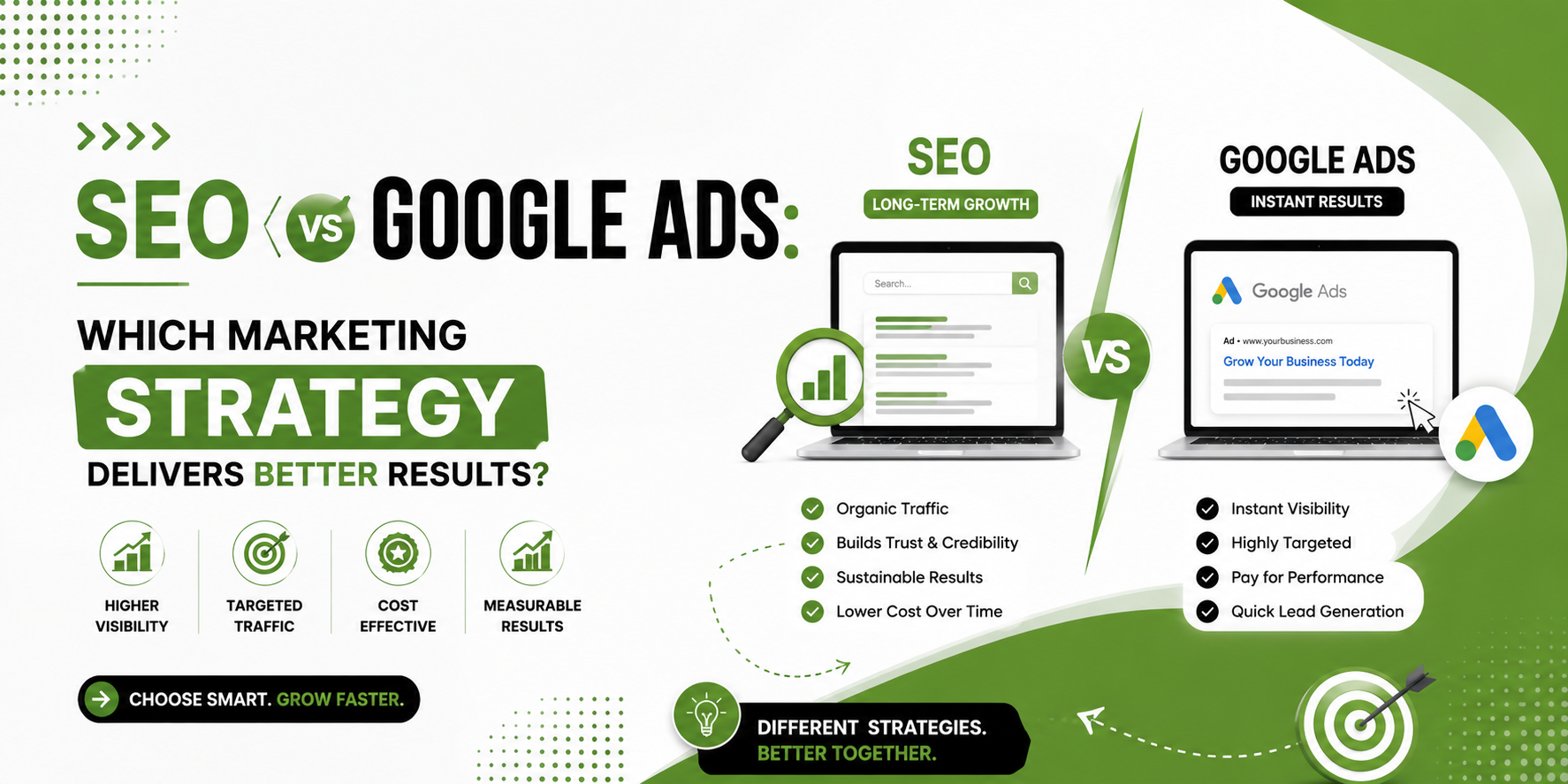
SEO vs Google Ads: Key Differences
| Factor | SEO | Google Ads |
|---|---|---|
| Traffic | Organic | Paid |
| Initial results | Usually slower | Usually faster |
| Long-term value | High potential | Depends on ongoing spending |
| Cost model | Investment in optimization/content | Usually pay per click |
| Brand authority | Strong potential | Good visibility |
| Budget flexibility | Long-term investment | Highly controllable |
| Best for | Sustainable growth | Immediate campaigns |
| Results after stopping investment | Can continue | Paid traffic generally stops |
Which One Is Better for Startups?
For startups, the answer isn’t always SEO vs Google Ads.
A better strategy can be:
Use Google Ads for Immediate Leads
If a startup needs customers quickly, targeted Google Ads campaigns can help generate traffic and test market demand.
Build SEO for Long-Term Growth
At the same time, the company can create useful content, optimize service pages, and build organic search visibility.
This creates a combination of short-term acquisition + long-term growth.
A Smart Digital Marketing Strategy
Instead of choosing only one channel, businesses can use both strategically.
Step 1: Start With Google Ads
Target high-intent keywords and measure which searches generate quality leads.
Step 2: Identify Winning Keywords
Analyze which keywords generate:
- Leads
- Sales
- Calls
- Enquiries
- High-quality customers
Step 3: Build SEO Around Those Keywords
Create high-quality landing pages, service pages, blogs, FAQs, and helpful resources targeting relevant searches.
Step 4: Optimize Based on Data
Use actual campaign and website data to improve both paid and organic strategies.
When Should You Choose SEO?
SEO may be the better investment if:
- You want sustainable organic traffic.
- You are building long-term brand authority.
- Your industry has valuable search demand.
- You regularly publish useful content.
- You can wait for results to develop.
When Should You Choose Google Ads?
Google Ads may be more suitable when:
- You need traffic quickly.
- You are launching a new product or service.
- You want to test market demand.
- You have a clearly defined advertising budget.
- You want to target high-intent searches.
The Best Approach: SEO + Google Ads
For many businesses, the strongest strategy isn’t choosing one over the other.
Google Ads can bring immediate traffic.
SEO can build long-term organic visibility.
Together, they can create a more balanced digital marketing system.
Paid Search → Immediate Visibility → Leads
SEO → Organic Visibility → Trust → Long-Term Traffic
The key is not simply generating traffic. The real objective is generating qualified traffic that converts into customers.
Conclusion
There is no universal winner between SEO and Google Ads.
Google Ads is powerful for speed and immediate visibility, while SEO is powerful for sustainable organic growth.
For startups and growing businesses, combining both strategies can provide the best of both worlds—immediate opportunities today and stronger organic visibility for tomorrow.
Growth with Tech
Build Smarter. Market Better. Grow Faster.